
If you've typed "real estate investing for beginners" into Google more than once this month, you're not behind. You're just at the part everyone skips talking about: the part where you don't know what you don't know yet. That's normal. Nashville's market has moved fast enough that even people who've owned rental property for a decade are relearning parts of it. If you're starting from zero, the good news is you don't need $100,000 in the bank or a finance degree. You need a plan, a few honest numbers, and people who'll tell you when your plan has a hole in it.
This isn't a "10 steps to riches" post. It's what we'd tell a friend who asked us where to start.
Why So Many People Are Trying This in Nashville Right Now
Nashville isn't a secret market anymore, and that cuts both ways for beginners. On one hand, there's real demand and real appreciation behind the numbers. On the other, more competition means less room for guessing.
| What's happening | The number | Why it matters to a beginner |
|---|---|---|
| Investment volume in the Nashville market | $5.1 billion in 2025 | That's roughly 40% higher than the year before. This isn't a market cooling off, it's one still attracting serious capital |
| Type of buyer active locally | Mix of first-time investors and portfolio landlords | Beginners aren't competing only against other beginners |
| Financing landscape | Shift toward creative financing (seller-carry, subject-to, partnerships) | A traditional 20% down investment-property loan is one option, but it isn't the only financing route available to investors |
Source: REIN, Real Estate Investing Nashville
None of that means you need to rush. It means the "wait until I know everything" plan tends to cost people the deals that would have taught them the most.
Learn Real Estate Investing Before You Learn to Buy
There's a difference between learning to invest and learning to buy a house. A lot of beginners skip straight to the second one: they get pre-approved, start touring properties, and only later realise they never picked a strategy. Fix and flip, buy and hold, wholesaling, and short-term rental all use the same word ("investing") but require almost nothing else in common.
Before you make an offer on anything, get honest answers to these:
- What's your actual timeline for a return? Flips want months. Rentals want years.
- How much of your own cash are you willing to tie up? This determines whether creative financing is a nice-to-have or a requirement.
- Who's going to manage the property day to day? You, a property manager, or nobody because you haven't thought about it yet. That last one is more common than people admit.
- What's your appetite for a project that goes over budget? On a rehab, something usually does.
If you can't answer these yet, that's fine. It just means education comes before contracts, not after.
The Mistakes That Actually Sink Beginners
Most of the beginner mistakes we hear about aren't dramatic. They're small miscalculations that compound.
| Mistake | What it usually looks like | The fix |
|---|---|---|
| Underestimating rehab costs | Budgeting for paint and flooring, not the electrical panel that fails inspection | Get two independent contractor bids before closing |
| Skipping the property manager conversation | Assuming you'll self-manage, then getting the 2 a.m. call | Price out management costs even if you plan to self-manage at first |
| Using one lender's opinion as gospel | Believing "that's just how financing works" from a single source | Compare terms across at least two lenders |
| Buying on a "gut feeling" about the neighbourhood | Skipping comps because a street "felt right" | Pull actual comparable sales before you commit |
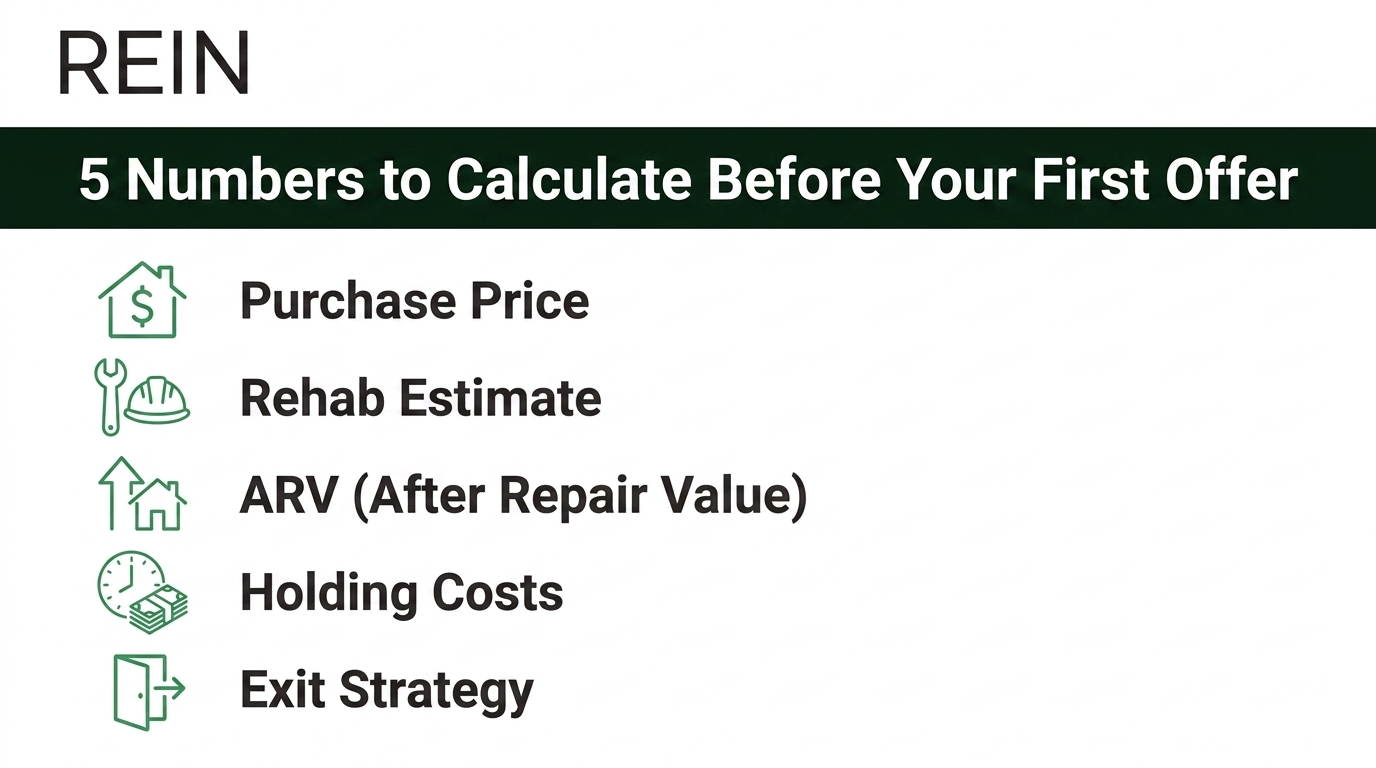
[Infographic placeholder] "5 numbers every beginner should calculate before their first offer": purchase price, rehab estimate, ARV, holding costs, exit strategy.
What Beginners Should Research Before Buying in Nashville Specifically
Beginner advice is often written for no city in particular. Nashville and Middle Tennessee have their own quirks worth checking before you write an offer:
- Property taxes by county. Davidson, Wilson, Rutherford, and Williamson County rates differ enough to change your cash flow math.
- Rental demand by neighbourhood. Urban-core renters and suburban family markets like Dickson or Mt. Juliet aren't the same tenant pool.
- Landlord-tenant regulations. Tennessee is generally landlord-friendly, but rules still vary by city ordinance.
- Short-term rental permits. Nashville's STR rules have shifted over the years. Check current zoning for the specific property.
- Insurance costs. Weather-related claims have pushed premiums up in parts of Middle Tennessee. Get a real quote, not an estimate.
This is a starting list, not a finished one. Talk to someone who already owns property in the area you're considering.
Your First 30 Days of Learning Real Estate Investing
If you want a practical starting framework instead of "just start learning," here's roughly how it breaks down:
- Week 1: Pick one strategy to study, buy-and-hold, flip, or wholesale, until you can explain its basic math to someone else.
- Week 2: Learn the core numbers: ARV, rehab estimate, and cash-on-cash return, until you can calculate them without looking up the formula.
- Week 3: Talk to a lender, a contractor, and a property manager, and get one real quote or conversation from each.
- Week 4: Attend an investor meeting and run the numbers on two or three real listings, even if you don't make an offer yet.
Some people move faster, some slower. The point is having a sequence instead of an open-ended "someday."
See What Beginners in the Room Are Actually Doing
Visiting a REIN meeting as a guest is a low-pressure way to sit next to people who've already made (and fixed) the mistakes above.
Visit a REIN MeetingWhere Beginners in Nashville Actually Learn This Faster
Here's the part most beginner guides skip: you can read every article on this list and still make a costly mistake, because articles can't answer a question specific to your deal at 9 p.m. on a Tuesday. That's the gap a real estate investing community fills.
REIN, Real Estate Investors of Nashville has run as a not-for-profit association here since 1980, so the "beginner mistake" list above isn't theoretical to the members in the room. It's been lived. New investors sit next to people who've done the deal you're about to try: the property manager conversation, the rehab bid that came in double, the lender who actually closes on time. Our Nashville Real Estate Investing 101 guide goes deeper on creative financing if that's the piece you're stuck on.
If you're the type who learns by watching other people's mistakes instead of making your own, visiting a REIN meeting as a guest is a low-pressure way to see whether this kind of community fits how you want to learn. If you haven't picked a group yet, our guide on how to find and evaluate real estate investor groups in Nashville walks through what separates a legitimate association from a Facebook group with a nicer logo.
FAQ: Real Estate Investing for Beginners
Do I need a lot of money saved to start real estate investing, or can I begin with little money?
No. Wholesaling requires the least capital since you're typically not purchasing the property. Buy-and-hold and fix-and-flip need cash for a down payment or rehab, but creative financing (seller financing, partnerships, lower-money-down programs) can reduce how much of that has to be yours.
What's the single best first strategy for a beginner?
There isn't one universal answer. Buy-and-hold suits people who want long-term, steadier returns. Wholesaling suits people with more time than capital. Fix-and-flip suits people comfortable managing a renovation. It depends on your cash, time, and risk tolerance, not a generic ranking.
What should I learn before investing in my first property?
At minimum: how to calculate ARV, how to estimate rehab costs, the basics of your financing method, and what a property manager costs versus self-managing. Everything else can be learned as you go.
Is joining a real estate investing community actually worth it as a beginner?
It depends what you're optimising for. If you want the fastest path to your first deal with the fewest expensive surprises, being around people already doing deals shortens that path considerably compared to learning alone.
How do I find real estate investors in Nashville to learn from?
Local real estate investors associations and structured networking groups tend to connect you with people actively doing deals, which is different from a general online forum.
Where to Go From Here
Real estate investing for beginners isn't about having every answer before you start: it's about knowing which questions to ask and having someone to ask them to. Nashville's market rewards people who move with a plan, not people who move fastest. If you're ready to trade guesswork for a room full of people who've already made and fixed the mistakes you're worried about, REIN's next meeting is a good place to start.
Ready to Trade Guesswork for a Plan?
REIN's next meeting is a good place to start.
Join REIN's Next Meeting